> For the complete documentation index, see [llms.txt](https://sharpsync.gitbook.io/sharpsync/llms.txt). Markdown versions of documentation pages are available by appending `.md` to page URLs; this page is available as [Markdown](https://sharpsync.gitbook.io/sharpsync/~/changes/zcOMaRcqMhiRElzWzdJZ/fundamentals/data-sources.md).
# Data Sources
A `Data Source` is exactly that - a source of data you configure to read/write data from, or a source of data with an add-in to push data to SharpSync.
A primary source will be a Bill of Materials (BOM) structure and metadata (e.g., part number, description, revision). A secondary source will be Inventory records and BOM data.
Each source may be registered as either a *Primary* or a *Secondary* Data Source.
It works as follows:
* *Primary Data Source* ↔️ SharpSync ↔️ S*econdary Data Source*
### Core concept: Sources
* A *Primary* Data Source is typically a CAD / PDM / PLM source. It is the origin of your CAD data.
* A S*econdary* Data Source is typically an ERP / MRP source.
* SharpSync uses both sources to do bi-directional synchronization, meaning it pulls information from the *Primary* and writes to the *Secondary*. It can also pull information from the *Secondary* and write to the *Primary*.
* Currently the application is limited to a single *Primary* source and a single *Secondary* source
### Core concept: Primary and Alternative Component Identifiers
SharpSync is a synchronization tool. It synchronizes data between two Data Sources. To do this, it uses the following two settings:
* Primary Component Identifier: The preferred property or meta data name to search
* Alternative Component Identifier: The alternative property or meta data name to search if the primary returns an empty result.
A Primary (or alternative) component identifier is the meta data, part number or custom property that uniquely identifies the component item (part, assembly, item or drawing) in a Data Source.
Typically this property (in a CAD environment) would be something like `Number`, `PartNumber`, `No`, `PartNo.` or similar.
Typically in an ERP system, this would be something like `Number`, `PartNo`, `ItemId`, `Id` or similar.
**Example**
Let's say we're working with a part called '123'. Our primary identifier is `'PartNumber'` and our alternative identifier is `'name'.`
The way SharpSync works is that it searches the source for the *Primary* identifier (in this case the primary identifier is `PartNumber`). So it searches the source for a component identifier `PartNumber` with a value of `123.`
If nothing is found using an exact match (i.e. no component identifier `PartNumber` with a value of `123`), it will search the source using the *Alternative Component Identifier*. In this case, the alternative identifier is`name`, so the source is searched for a component identifier `name` with a value of `123`.
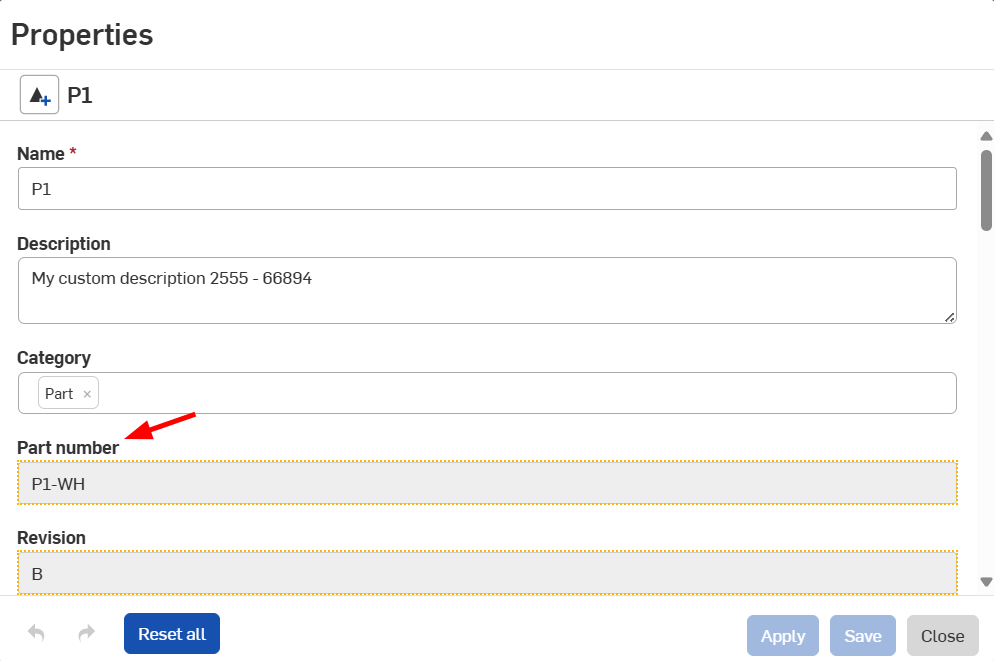
As an example of a Primary Identifier, we have included a screenshot from OnShape. This will of course vary from other platforms:
OnShape Property Map
### Core concepts: Setup
To complete a Data Source's setup, you have to complete at least the following two items:
* Setup authentication
* Setup BOM configuration
### Resource links
Select an individual Data Source to view the configuration setup for that source.